Wednesday, November 30, 2011

http://a.espncdn.com/photo/2011/0403/la_a_angelslose1_576.jpg

By Chuck Richter - AngelsWin.com 

Yes it would be nice to add a big bat such as Prince Fielder or Albert Pujols, but if that type of signing results in not improving other areas of the club that failed miserably in 2011 I don't think it's worth it. That said I wouldn't complain if Dipoto is able to reach deep into Arte's pocketbook this winter and sign or trade for a difference maker on offense along with my suggestions. 

So, here's a quick look at three areas of focus I believe the Angels should look at to improve their club this winter. Three areas of weakness that saw the Angels fall short of winning the AL West for the second straight year to the hands of the Texas Rangers.

1.) Relief Pitcher - If the Angels can add a couple of solid bullpen arms in hopes of improving a shaky 2011 bullpen that led the league with 25 blown saves, there's a good chance they add 10-15 wins in the standings in 2012. Scott Downs was solid as usual, but while Jordan Walden has closer stuff he hasn't figured out how to put away hitters consistently late in the game, having trouble locating his high 90's fastball and slider. The Angels' bullpen was already better after the last game of the 2011 season just by the subtraction of Fernando Rodney, but adding a couple arms from the following: Heath Bell, Juan Cruz, Mike Gonzalez, Francisco Cordero, Kerry Wood, Ramon Ramirez, Jeremy Affeldt, Rafael Betancourt, Ryan Madson, (if the price is right) would solidify the Halos bullpen in 2012 and put them in a good position to overtake the Texas Rangers for the AL West title.

2.) Catcher - The Angels catching core across the board, in 2011 especially Jeff Mathis (.174/.224/.259) who played in the majority of games behind the dish (93), was a gigantic hole in a lineup that was held to two runs or fewer 51 times this past season. Signing Ramon Hernandez or trading for Chris Iannetta to start 65 %  of the games in a time share with Hank Conger would be a boost in production.

3.) Starting Pitcher - Why would the the Angels who were 58-42 in games started by Weaver, Haren and Santana, who combined for a 45-30 record with a 2.98 earned-run average and 568 strikeouts in 7022/3 innings need another starting pitcher? Here's why. If the Halos shore up the bullpen, add some offense at the catching position, and add another starter like local product C.J. Wilson, it would not only cripple the American League Champs by signing the ace of their staff, but improve yet another facet of the Halos game which was so awful in 2011 and make them strong contenders in 2012. Tyler Chatwood and Joel Pineiro were terrible in the #4 and #5 spots. Joel Pineiro posted a 5.13 ERA and 1.51 WHIP, while Chatwood had his moments as a rookie, he posted a 1.67 WHIP and 4.75 ERA and put Angels in a terrible position to start many games as the offense was behind 4-5 runs early on. The Halos could boast the league's best rotation in the game if they sign C.J. Wilson to go along with a resurgent Jerome Williams who posted a 2.95 ERA in his nine appearances in six starts from the 5th spot of the rotation.

Conclusion: If the Angels can shore up these three needs before the 2012 season – to go along with an addition of Kendrys Morales in the lineup – I believe they will put themselves in a good position to overtake the Texas Rangers for the AL West.

Tuesday, November 29, 2011

http://latimesblogs.latimes.com/.a/6a00d8341c630a53ef014e87435a9c970d-800wi

By Jonathan Northrop - Angelswin.com Columnist

…which brings us to the last part of this Offseason Primer: the bullpen. But never fear, my faithful readers, because--considering that these articles became longer than I expected (I couldn’t help diving into the history of the team)--I will write an eighth part as summation, looking in particular at the Angels right now and what we might expect for the next year or two. But first, the ‘pen…

Stoneman’s Legacy
If there was one aspect of the GMing business that former Angels GM Bill Stoneman (1999-2007) was good at, it was—no, I’m not talking about holding onto prospects, no matter how good or mediocre they are—assembling a good bullpen. Starting with 2011 and going back to Stoneman’s first year as GM (1999), here is how the Angels’ bullpen has ranked in the AL (14 teams) in runs per game, with Stoneman’s years in bold: 2, 7, 10, 5, 5, 5, 4, 2, 2, 5, 1, 4, 9, 4

In other words, during Stoneman’s reign, the Angels had a top five bullpen in the AL in every year except for one, led by stand-outs Troy Percival, Scot Shields, Brendan Donnelly, and Francisco Rodriguez. This is a tradition that remained until the bullpen dropped precipitously in 2009, ranking 10th in the league in runs per game, then showing steady improvement over the last two years to rank 2nd in the AL in 2011. 

2011 - A Return to Greatness?
For those remembering numerous Jordan Walden blown saves and Fernando Rodney’s walkathons, this may come as a surprise, but the Angels bullpen was very good in 2011; of relievers with 16 or more innings pitched, only Fernando Rodney had an ERA over 4.00 with 4.50; the second highest was Hisanori Takahashi with 3.44. So last year, these were the Angels’ relievers with at least 20 IP out of relief, in order of innings pitched, and their ERAs:
  • Takahashi: 3.44 (68 IP)
  • Walden: 2.98 (60.1 IP)
  • Thompson: 3.00 (54 IP)
  • Downs; 1.34 (53.2 IP)
  • Cassevah: 2.72 (39.2 IP)
  • Bell: 3.41 (34.1 IP)
  • Rodney: 4.50 (32 IP)
Despite an AL-leading 10 blown saves, closer Jordan Walden’s rookie year has to be considered a success; he was only 23, held his own in a high-pressure role, and should only get better. Free agent signings Takahashi and Downs provided the Angels with over 100 innings of low-2.00 ERA relief; despite perhaps over-paying for both, we’ve got nothing to complain about with either pitcher. Young pitchers Rich Thompson and Bobby Cassevah both had break-out years, especially Thompson--Cassevah's peripherals make him a question mark going forward, but he was a solid pitcher in 2011. Only Rodney was bad (especially his 7.9 walk rate), but he’s gone.

Going into next year, Walden, Downs, Takahashi, and Thompson are locks, with Cassevah and Bell also in the mix from last year. Kevin Jepsen will deserve another look and Michael Kohn may finally breakthough. The Angels are likely to sign at least one free agent reliever, although there may be help coming up from the farm.

2012 and Beyond
As with the rotation, the Angels have a wealth of relief prospects. After Michael Kohn, who has flirted with a major league role but has struggled with command issues (25 walks in 33.2 career major league innings), the Angels have a large group of options that may see major league time as soon as next year, including Jeremy Berg, Steven Geltz, Matt Meyer, David Carpenter, Ryan Brasier, Loek Van Mil, Robert Fish, and Daniel Tillman, not to mention minor league starters such as Matt Shoemaker and Ariel Pena that may end up as middle relievers.

The Angels are so stacked with potential major league pitchers—both starters and relievers—that there would be little reason to sign or trade for free agent pitchers beyond a patch here and there, at least beyond this offseason. That said, after those 10 blown saves, management and fans may have lost patience with Jordan Walden and rumors are flying that Jerry DiPoto is looking for relief help, whether a Heath Bell, a Carlos Marmol, or a lesser luminary like Octavio Dotel or Scott Linebrink. 

All in all, the bullpen is one area of the team that fans and the front office alike have little need to worry about. The pitching staff is, and will remain to be so for the foreseeable future, a team strength. This doesn’t mean that we won’t see some tweaking, but that the team is operating from a position of strength.

Monday, November 28, 2011

http://a.espncdn.com/photo/2011/0728/la_ag_weaver_haren_santana_b1_576.jpg

By Jonathan Northrop - Angelswin.com Columnist

A Brief History of Angelic Aces
For most of the franchise’s 51-year history, the Angels have had a clear staff ace—a pitcher who, if not always one of the best in the league, was clearly the top pitcher on the team. During the first half of the 60s it was Dean Chance who, while only playing a bit over five years for the Angels from his first five games in 1961 through 1966, compiled a 2.83 ERA during that span and a Cy Young Award in 1964 when he led the AL with 20 wins, a 1.65 ERA, 278.1 innings, and 11 shutouts.

After Chance was traded to the Twins after the 1966 season for a couple of power hitters, a couple years passed before Andy Messersmith emerged as the ace in 1969 and pitched for the Angels through 1972, the staff being co-led by Clyde Wright who he broke out as a strong starter in 1970 at the age of 29. It was before that year during the offseason that the Angels traded aging star shortstop Jim Fregosi to the New York Mets for a package that included a young flamethrower by the name of Nolan Ryan. Fregosi had had his last great year in 1970 while Ryan was just getting started. Nolan Ryan simply was the Angels in the 70s: from 1972 to ’79 he pitched 2181.1 innings and struck out 2416 batters, also walking 1302, setting the modern era major league record for strikeouts in a single season with 383 in 1973 (everyone above that mark pitched in the 1880s).

Ryan got all of the press during the 70s, but Frank Tanana might have been a better pitcher. Between 1974 and 1978, Tanana won 82 games for the Angels; over his eight years with the Angels he won 102 games with a 3.08 ERA and 1233 strikeouts with only 422 walks in 1615.1 IP. In other words, at his height Tanana was probably a more effective pitcher than Ryan, though after an injury in 1979, Tanana was never quite able to recover and became a solid, but unspectacular mid-rotation starter. Tanana was only with the Angels for another year, though he pitched for thirteen more seasons.

From Ryan and Tanana, the mantle of staff languished for a couple years in the hands of Ken Forsch and Geoff Zahn until Mike Witt emerged. Witt was the team’s best starter for a few years in the mid-to-late 80s, but declined early in his late 20s and was out of baseball at the age of 30. After Witt, a series of excellent starters vied for the staff ace role including Bert Blyleven, Kirk McCaskill, and Jim Abbott. But starting in the late 80s and going all the way through to 1999, the Angels staff was led by one man: Chuck Finley, the all-time franchise leader in innings pitched with 2675 (for context, number two is Nolan Ryan with 2181.1; John Lackey is fifth with 1501, and Jered Weaver is just outside of the top ten with 1131.2), wins (165) and losses (140). Finley may not have been a great pitcher—although he had a few great years—but he was good to very good for over a decade, and the face of not only the pitching staff but, along with Tim Salmon, the Angels team during the trials and tribulations of the 90s.

Tuesday, November 22, 2011

https://blogger.googleusercontent.com/img/b/R29vZ2xl/AVvXsEhDDwQ-mBQp2MLiptEmqXUk0ZyRoUKL52R1ni_B6SGO7c5VkugoPLRKyL1bdbiI_yZdpzgqson_mKwOx3GJn-0iin9SMjnzZ-3aUrtBrs4joNMsCjUJHuZTrUPWlSGAn2jsiFJ80YzddGxp/s1600/Blake+Gailen.jpg

Interview Conducted by David Saltzer, AngelsWin.com Senior Writer

As we head into the holidays, there are many things for which we should all be thankful. Whether it's our health, our family, our friends, being Americans, our jobs, we all have things to appreciate.

Baseball fans, though, have one more thing about which we should be thankful. We should be thankful for the hard work, dedication, and perseverance from Minor Leaguers such as Blake Gailen to make the sport we love that much better.

Imagine being Blake Gailen. You’re talented. You play hard. You do all that you are supposed to do in high school. You letter in baseball all four years at El Camino Real High School and are named to the first team All-West Valley League as a junior and senior. However, for some reason, the scouts pass you up. They say you don’t have the “look” or the “build” of a Major Leaguer. You aren’t drafted.

So, you go to Junior College. You don’t give up the dream—you keep working at it. As a freshman in Junior College you win All-Western State Conference honors. You follow that up as a sophomore by winning All-Southern California accolades. However, again, you go undrafted for the same reasons.

So, you continue on to a 4-year college: UNLV. Undrafted as a junior, you continue on as a senior. Again, no pro offers come. The scouts keeping giving the same feedback about your build. How many of you would have hung up your cleats at that point?

Blake, however, continued into Independent Baseball. Over the next 4 years, he persevered, both as an outfielder and a pitcher. He excelled as a player, but no pro offers came. How many of you would continue to chase the dream of playing Major League baseball for four more years under those circumstances?

Unlike most, Blake defied the odds. On July 27th, 2011, Blake Gailen had his contract purchased by the Angels. Before you think that this was an easy decision, listen to Blake describe his status as a Minor Leaguer. Chasing the dream resulted in him taking nearly a 20% paycut. Again, how many of you would take a 20% paycut to continue to chase such an elusive dream?

The Angels assigned Blake to the Double-A Arkansas Travelers. After getting off to a fast start, he ended the season with a .208/.322/.366 line in 29 games. He hasn’t given up the dream, and is trying to become one of the few Major League players to ever come entirely from Independent Baseball.

So, as we settle into the holidays, sit back, relax and listen to the struggles that players like Blake Gailen endure. And then, as baseball fans, give thanks that there are players like Blake Gailen out there working hard everyday, staying in shape, giving 110% every chance they have so that you can enjoy the great game of baseball.

Click here to listen to the AngelsWin.com interview with Blake Gailen.

Wednesday, November 16, 2011

http://i.usatoday.net/sports/_photos/2011/07/18/AngelsMike-Trout-still-fish-out-of-water-JE7T29C-x-large.jpg

By Jonathan Northrop - Angelswin.com Columnist
 
This is the fifth part in a series that looks at the Angels team--where it is today, how it got there, and where it might be going. The four previous parts can be found here, with further parts listed:
OFFSEASON PRIMER - PART FIVE: THE OUTFIELD

Oh Those Sweet 90s
When you think of the “90s,” what pops into your mind? I’m not talking about Ethan Hawke and Nirvana and Starbucks coffee – this is a baseball blog, after all. I’m talking Angels baseball, and for long-time fans of the club the 90s were anything but sweet. It was a very bad decade for the Angels, but also a transitional one. But let’s back up for a moment before I get to the sweet part.

For those new to Angels fandom, the first couple decades of the franchise—the 60s and 70s—were the definition of mediocrity. The team didn’t make the postseason until 1979 and they didn’t win more than 88 games in a season until 1982 (strangely enough, the Angels are a franchise that has never lost more than 95 games).

From the late 70s into the early 90s, the Gene Autry-owned Angels followed a consistent formula: Focus on free agents and use the farm system primarily as a source of trade fodder. This approach led to three division winners in ’79, ’82, and ’86, but no championships. While the Angels of the late 80s combined aging has-been stars with solid farm-raised talent that included Wally Joyner, Devon White, and Chuck Finley, it wasn’t until the early 90s that the team really shifted its philosophy and focused on developing a homegrown core. The watershed moment may have been in 1993 when a 24-year old outfielder by the name of Tim Salmon won the AL Rookie of the Year (you may have heard of him). Salmon was merely one of a talented young group to come up between ’92 and ’95 that included outfielders Chad Curtis, Garret Anderson, and Jim Edmonds (and, in ’96, Darin Erstad), infielders Gary DiSarcina, Damion Easley, JT Snow, and Eduardo Perez.

Sunday, November 13, 2011

http://media.cleveland.com/startingblocks/photo/alberto-callaspo-apjpg-2e58575111bbe406_large.jpg

By Jonathan Northrop - Angelswin.com Columnist

This is the fourth part in a seven-part series. The previous three parts can be found here:
There's No Glausing Over It: A Troublesome Recent Past
As I mentioned in Part One, recent history for the Angels has been particularly problematic at catcher and third base. Both positions carry, for different reasons, a patina of infamy. At catcher you have the Saga of Mathis and Napoli, at third base you have a position that has been unstable for nearly a decade. A decade, you say? Wasn't Troy Glaus an Angel through 2004?

Let's dial back to the end of the 20th century. Troy Glaus was part of a very promising generation of young third basemen that included Scott Rolen as the elder statesman (the NL Rookie of the Year in 1997), followed by Eric Chavez, Fernando Tatis, Adrian Beltre, and Aramis Ramirez--all making their debuts in 1997 or 1998. Like many of those players, greatness was expected of Glaus who, after leading the AL with 47 home runs and with an OPS of 1.008 (and an 8.3 WAR) in 2000, looked like a superstar in the making--all at the relatively tender age of 23. Granted, it was the height of the "Roidball" era and Glaus was later indicated as a user, but that kind of offensive production was nothing to sneeze at. When Glaus' numbers fell to 41 HR/.898 OPS in 2001 Angels fans thought it was a slight down-turn but weren't too worried. But then in 2002, his numbers dropped further to 30 HR/.805 OPS and it looked like Glaus wasn't going to be a superstar after all, merely a star or borderline star. But a World Series MVP performance eternally ingratiated fans to Glaus and he was expected to man the hot corner for the next decade.

2002 was the last year that Glaus played a full season for the Angels. In 2003 and 2004 he totalled 149 games and then, after the 2004 season, he was released to the waters of free agency. Why was he, just 27 years old, let go of? The Angels had a top prospect by the name of Dallas McPherson who had, in 135 games in AA and AAA in 2004, hit an astounding .317/.387/.670 with 90 extra base hits, including 40 HR. The Angels felt confident that McPherson would more than fill in for the injury-prone Glaus, and at a less expensive cost.

It just wasn't in the cards. McPherson battled injury for the next two years, playing 61 games in 2005 and then 40 in 2006. During those two years he would follow a pattern of starting slow, getting hot and then sustaining an injury. Then, after rehabbing, he'd come back and start the cycle all over again. Finally, after missing all of 2007 to injury, the Angels released him after the season. Glaus, meanwhile, re-established himself, hitting 75 HR in 2005 and 2006, the two years that McPherson struggled to stay healthy enough to remain in the lineup. Glaus hit another 20 HR in 2007, 27 in 2008, then missed most of 2009 and struggled in 2010 before retiring with 320 HR and a .254/.358/.489 line - a very nice career, although not quite what had been hoped for after his 2000 career year.

The Angels attained stability at the corner for a few years in 2007 to 2009 when Chone Figgins, previously a super utility player, took over, sharing duties with Maicer Izturis in the first couple years. By the time that Chone was the full-time third baseman during his career year in 2009, he was an excellent defensive player. But the Angels decided to let him go after the season because they hoped that another (former) top prospect, Brandon Wood, would take over. Despite the fact that some analysts panned the Angels for letting Figgins go to division rival Seattle, the decision turned out to be a wise one as Chone completely fell apart in Seattle and is now a bench player (Angels fans may enjoy the irony that sportswriter Rob Neyer called Figgins a "superstar" after he was signed by--and flopped for--his hometown Mariners).

Which brings us to Brandon Wood. The 23rd pick in the 1st round of the 2003 amateur draft, Wood didn't really breakout as a top prospect until his monumental 2005 season when he hit .321/.381/.667 with 101 extra-base hits, mainly for A+ Rancho Cucamonga at the age of 20. Wood vaulted up the prospect charts and it has been all down hill for him since. His numbers were still good, but more modest, in AA the following year, when he hit .276/.355/.552 with 71 extra base hits. His numbers dropped further in AAA the following year and he spend the better part of three years--2007-09--in AAA, waiting for his chance to break into the lineup. At first, as a shortstop, he was competing with Erick Aybar, but Scioscia seemed to prefer the slicker-fielding Aybar who won the starting job in 2008, while Wood struggled in a month and a half long stint in the majors. Wood spent most of 2009 back in AAA and then got another chance in 2010 after Figgins departed, but was an absolute flop, hitting .146/.174/.208 in 243 PA, one of the worst performances with that many appearances in major league history. Just six games into the 2011 season and Wood was selected off waivers by the Pittsburgh Pirates. In Pittsburgh he wasn't quite as terrible but still managed only a .220/.277/.347 line.

Wednesday, November 9, 2011

https://blogger.googleusercontent.com/img/b/R29vZ2xl/AVvXsEhIG6WNFe2RXjSEs0YMCk3dXKB5-DUpaZGKA4jCEfYPqjxe2w2rAqV3brQI64oKgfXOzKWQp3dvu9FHrrt2LXXpxBdvmfqiNFrygV_7Jb5teVYu0UOANsj0YVyB-u-2HdvN_CoF5c4ENOE/s1600/Gift+of+History+2011.jpg

By David Saltzer, AngelsWin.com Senior Writer

This isn’t going to be another article about Trumbo, Bourjos, Conger, Chatwood and Walden. The baseball season is over. The holidays are almost upon us. It’s time to think of more than what happened on field in 2011 or what might happen in 2012.

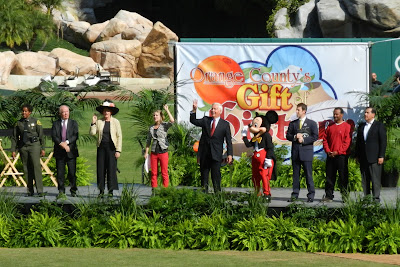
This article is, however, going to be about kids—nearly 20,000 kids who attended the Gift of History program held at Angels Stadium. Billed as the largest history lesson ever (as confirmed by a Guinness World Records representative), most of Orange County’s 3rd graders were treated to a fun and entertaining morning dedicated to the unique history of the County.

As an Angels fan, I take pride knowing that the team I root for is constantly acting as a positive force within the community. It has always been that way. In a time when the reputations of many corporations are coming under fire, knowing that the team I’m passionate about is dedicated to being a good corporate partner makes me feel that much better about supporting the team.

When I asked Tim Mead, the Angels’ Vice President of Communications, about the Angels’ dedication to the community, he said “Well I think it has always been there and it continues to be enhanced. Mr. Autry was one of the first philanthropic people when you look back at his history across the country. It was very important to him when all of us started here. Involvement in the community was part of our responsibility—to go out to speak, to take care of people. Disney enhanced that. When you look at everything that Disney does on a grand scale, there’s no comparison. And then under Arte’s ownership, he’s continued that on an individual basis. We’ve really expanded our baseball foundation, our community relations endeavors . . . We take our community responsibility very seriously.”

Dennis Kuhl, the Angels Chairman, who was just beaming as he stared out at the kids cheering away to Mickey Mouse and Jose Mota, said “We sometimes focus or we hear too much about the bad kids. We don’t focus enough on the good kids and making a difference in their lives and giving them an opportunity. Today, there is a possibility that a kid comes here, he sees this, and says ‘you know what? I’m going to make the choice to turn my life around and make sure I do good and I appreciate this.’

As I spoke with teachers (without whom this event could not have been possible—imagine trying to take 30 or more 7 and 8 year olds on a bus to Angels Stadium, dealing with all the issues such as bathroom trips, seating arrangements, lost children, locating buses in a parking lot, etc.), they explained the value of an event like this. They said that for most students, history is difficult to understand because they cannot always see it or relate to it. Over the course of the school year, the 3rd grade teachers will refer back to this event to make the history lessons about Orange County more “alive.” They will use the facts in the book “Nothing Rhymes with Orange” that every student in attendance received and images from the Gift of History event to remind the students of what they saw. The teachers explained that it was the passion and energy from this event that will make their classroom lessons more meaningful.

It’s also that level of passion that drives Arte Moreno to support local endeavors. For example, last Saturday, the Angels opened up the stadium for the Challenger Little League Classic, allowing 800 special needs children to play baseball on the Major League field. In the coming months, the Angels will host several holiday toy drives and events to support families in the community. Arte Moreno is committed to the community long-term. As Dennis Kuhl explained, “The thing with Arte is that he gives me the opportunity to do this and encourages this. There is no owner that I know of that cares about kids more than Arte . . . he is the force behind this . . . The passion starts at the top and goes right down, and that is the culture we want.”

Since the Angels announced the signing of Jerry Dipoto as the new General Manager, I have heard members of the front office talk about the new culture that he brought with him. However, there is one area of the organization’s culture that I never want to see changed—I never want to see them change their desire to be a good civic neighbor. All of Orange County benefits by having them as a part of our community.

As the event closed out, Dennis Kuhl told me one last thing. “If it works for one kid, it is worth every effort we put into this.” I couldn’t agree more. The Gift of History event will be an annual event that all Orange County 3rd graders can look forward to attending. With the strong support of the Angels, Disney, and many other local businesses, it will be a great gift to kids everywhere in the County. Who knows, maybe one of them will grow up to play for the Angels.

P.S. All 3rd graders have a chance to win one of several prizes by logging onto www.ocregister.com/rie and submitting an essay of 100 words or less answering the question “What Does Orange County History Means to Me?” Teachers, the grand prize in the contest is a $500 Toys R Us Shopping Spree for the student and a $200 Visa Gift Card for you!

Sunday, November 6, 2011


By David Saltzer, AngelsWin.com Senior Writer

Jerry,

I was very impressed by what you said and how you presented yourself at the introductory press conference. I like the staff that you are assembling and am excited to see what you will do to the team as the new GM. From all I’ve read and heard, you’re the right man for the job. Good luck in your tenure as the new Angels GM.

I agree with you that the core of the team is solid. A major overhaul isn’t needed, but the offense needs a major infusion of power. It’s going to take more than minor tinkering to fix all that ails the team. Here are my thoughts as a fan as to what you should accomplish this offseason.

Housekeeping

The Angels are losing Russell Branyan, Joel Pineiro, Horacio Ramirez and Fernando Rodney. Don’t worry about what you might be losing with them—it wasn’t much. Of the bunch, only Pineiro played an important role for a time while he was here. Unfortunately, none of that came in the second half last year when he fell apart on the mound.

There is, however, one important area of housecleaning that you must do. It’s a decision that you need to make right away. You have to designate Jeff Mathis for assignment.

I know that you believe in the importance of the pitcher/catcher relationship. And, I will agree with the experts that Mathis is the best defensive catcher that the Angels have right now. But, Jeff Mathis still has to go. Whether Weaver, Haren and Santana perform better with Mathis behind the plate is not as important as what this move will do to your credibility with the fans.

Unfortunately Mathis has become the focus of the fans’ anger and frustration with an anemic offense. Designating him for assignment will immediately give you credibility with the fans that you are the one calling the shots and will free up about $2 million for you to spend elsewhere. If for no other reason, you have to do this as a marketing move. If the fans see Mathis as the Opening Day starter behind the plate, attendance will suffer, especially early on in the season.

The Offense

The Angels have the pitching to keep them in games, but don’t have enough offense to win them. Fixing the offense will take a lot of pressure off of the starters and the bullpen. Vastly improving the offense will do the most to improve the team and bring October games back to Anaheim. Right now, the Rangers generate more offense than the Angels at 3B, C, LF, CF, and RF. While the Angels have superior starting pitching and defense, they won’t compete with the Rangers until they close the gap in offense.

To fix the offense you are going to have to be creative. It’s going to take one major Free Agent (one very expensive one) and two trades.

Move #1: Fix the Offense by Signing Prince Fielder to a 6 year/$120 Million Deal with a 1-Year Option

I know that Mr. Moreno has said that he’s comfortable with a payroll in the $130-$140 million range. With all the money already committed to players that might appear to price the Angels out of the major FA market.

But as we both know, deals that might seem difficult can be structured in such a way as to not make them impossible. Under the deal I would offer, it would be structured as follows:

Year 1: $10 million
Years 2-6: $22 million
Year 7 (option): $27 million with a $6 million buyout

The payout for this deal amounts to $21 million/year, with a minimal amount deferred so as to allow the Angels to shed some payroll to accommodate the higher payout—which is exactly what the Angels will do. This contract will work for Fielder because he will still be young enough at the end of it to sign on more major contract to close out his career.

Bringing in a left-handed middle of the order bat will do more to solve this team’s offense than any other potential move. In fact, it will do more to cause the Angels to win more games than any other potential moves. It will immediately give a dramatic boost to OB% and SLG% which will increase run production. The Angels didn’t lose the West by pitching poorly—they lost the A.L. West by failing to score consistently.

Don’t worry about what might happen if Kendrys Morales returns in 2012. After watching the offense struggle for an entire year, fans would rather have too many offensive options than too few. If need be, you can always make a trade at the deadline if he is healthy, but, most likely won’t be able to make a trade to boost the offense next year.

Move #2: Fix the Hole at Catcher by Trading Kole Calhoun and Ariel Pena for Kurt Suzuki

Oakland appears to be willing to listen to offers on anyone, and there is someone that the Angels need to target. I know that trading within a division is always tough. However, with Oakland’s stadium deal still in limbo, and their fanbase shrinking, there is a possible convergence of interests and needs to make a deal here.

Kole Calhoun is an ideal for Oakland who unfortunately will be unable to break into the Angels’ outfield. With Bourjos, Hunter, Trout, and Wells all penciled for OF spots with the Angels, and Trumbo needing a new position (thanks to move #1), there will be no spot for Calhoun to play. Oakland would value the mix of power and patience that he has and would be better off trading in Suzuki for some players who will help them when they get a new stadium.

As for Ariel Pena, while I would prefer not to include him in the deal, I recognize that trades within a division are a bit more expensive. I believe he has the stuff to be a Major League starter. However, as you will see in our Top-50 Prospect List for the Angels, the organization does have some depth in the lower levels for pitching, such as Hellweg, and could afford to make this trade without depleting the organizational depth at pitching.

If you are unable to trade for Suzuki, then we still will need a veteran catcher. I would prefer signing Ramon Hernandez, and believe that he could be had for a 2-year/$7.5 million contract. That would still fit within the existing payroll structure.


Move #3: Solve 3B by Trading Callaspo, and Wilson for Pedro Alvarez

While the easiest move to solve 3B might appear to be to sign Aramis Ramirez, I would rather see the Angels rely on a combination of younger players here. Long-term, the Angels have Kaleb Cowart in the organization to play 3B, and I want to stay close to Mr. Moreno’s payroll demands. I’m still not convinced that Ramirez will play so well in Anaheim and Callaspo does not provide enough offense to justify him playing 3B full time. So something has to be done to fix this hole in the lineup without breaking the budget.

Trading for Alvarez is a risk; he did regress last year. But, maybe a change of scenery would work for him. The Pirates seemed to have soured on him, so, this may be a chance to buy low on a player.

With Alvarez at 3B, the Angels could still get Trumbo into the game about 40-50 times at 3B. Alvarez is a lefty, so Trumbo could form a natural split at 3B with him. The Angels could get Trumbo into about 30 more games at 1B to keep Fielder healthy (giving him about 30 games at the DH spot), about 30 games in RF, and about 30 games as the team’s DH. It will be hard for Trumbo to manage all the different positions, but, he should be up for the challenge.

Now there is the possibility that the Mets would trade David Wright for Peter Bourjos and Tyler Chatwood. I would not do that move without being given the opportunity to sign Wright to an extension and until I knew that I could not sign Prince Fielder. Weaver, Haren and Santana are flyball pitchers. Having Bourjos’ defense in CF makes them that much better—and ultimately having that improved pitching and defense is what the Angels will use to beat the Rangers in 2012. In 2013, when Trout roams LF, Bourjos patrols CF and Wells is moved over to RF, the OF defense will become even better, which will give the Angels a big advantage. Weakening the OF defense does not make as much sense given our how our rotation is setup.

Trading 5 years of Bourjos at low cost does not make that much sense when it immediately voids the final year of Wright’s contract. It makes signing Prince Fielder that much more unlikely, and between Wright’s offense and Fielder’s offense, I’d rather have Fielder in the lineup. Plus, there is always the possibility that Wright is not fully recovered from his injury. So, trading for Wright wouldn’t be worth it unless Mr. Moreno will expand the payroll to $145 million or Fielder will not sign with the Angels.

I would, however, prefer Wright to signing Ramirez to play 3B.

Move #4: Save Some Money by Trading Abreu + $5 million for Prospect(s)

Yes, it’s a salary dump. But, the Angels don’t have the space on the roster to carry him. While no team wants to pay a player to play elsewhere, see this for what it is—a chance to save some money to improve the team in other areas. If no team emerges as a trade partner, then keep Abreu for the bench.

The Rotation

As you said, you can never have enough starting pitching. Both Jerome Williams and Garrett Richards proved that they deserve a shot at starting in the rotation (in that order). But, a solid 4th starter would help. The Angels won’t get by trying to break two pitchers into their rotation. So . . .

Move #5 Sign Aaron Harang to a 2-Year/$12 million Deal

Getting to the playoffs is all about winning series. Having a solid #4 will go a long way towards ensuring that the Angels will play in October. Harang is local and probably would sign for a contract in this range.

While I would rather get a lefty for the rotation, I don’t think that there are better options for a lefty in this price range. So, I would rather have a righty who would give me a better chance to win games than pursue a higher priced lefty and shortchange the offense.

The Bullpen

At this point, I have to admit, the team is out of money. With the budget constraints as they are, even a superhero couldn’t fix all the problems that plague the team.

The good news is that the Angels do have plenty of internal help for the bullpen. Daniel Tillman, David Carpenter, Robert Fish, and Chris Scholl are all close to the Major Leagues. If the internal options don’t pan out, and the bullpen continues to struggle, then there should be more options available at the trade deadline and it might be easier to convince Mr. Moreno to increase the payroll if the team looks a lot better. My bet is that with all the changes suggested here, the team will be much better off.

Conclusion

Putting it all together, here’s my Opening Day lineup for the team:

1. Aybar, SS (R)
2. Kendrick, 2B (R)
3. Fielder, 1B (L)
4. Hunter, RF (R)
5. Trumbo, DH (R)*
6. Alvarez, 3B (L)
7. Wells, LF (R)
8. Suzuki, C (R)
9. Bourjos, CF (R)

* Assuming that Morales is not ready to open the season playing for the team. If Morales is ready, he bats 3rd and Hunter drops to 5th, Wells moves to 6th and Alvarez moves to 7th.

And, here is my Opening Day rotation for the team:

1. Weaver
2. Haren
3. Santana
4. Harang
5. Williams
Closer: Walden

As a fan, this is a team I would pay good money to see take on the Rangers and the rest of the A.L. West.
Copyright © 2013 Los Angeles Angels Blog | AngelsWin.com

AngelsWin.com is the unofficial website of the Los Angeles Angels of Anaheim. Our comments and views do not express the views of the major league club or anyone affiliate with the Los Angeles Angels of Anaheim.  AngelsWin.com blog content, articles and opinions are provided "as is" and without warranties of any kind.  We disclaim warranties, express or implied, including warranties for a particular purpose, accuracy, completeness, availability, security, compatibility and non-infringement.  Blog material, articles and other information furnished or supplied by you to AngelsWin.com become the ownership of AngelsWin.com for use at our discretion.  Your use of AngelsWin content is at your own discretion and risk. We do not warrant that any content here be error free that access thereto will be uninterrupted or errors will be corrected. We do not warrant or make any representations regarding  the use of any content made available through AngelsWin.com  You hereby waive any claim against us with respect thereto. AngelsWin.com may contain the opinions and views of other members and users. We cannot endorse, guarantee, or be responsible for the accuracy, efficacy or veracity of any content generated by our members and other users. The content of AngelsWin.com is intended for educational and entertainment purposes only. Such content is not intended to, and does not, constitute legal, professional, medical or healthcare advice or diagnosis, and may not be used for such purposes. Reliance on any information appearing on AngelsWin.com is strictly at your own risk. Always seek the advice of your physician or other qualified health provider with any questions you may have regarding a medical condition. You should not act or refrain from acting on the basis of any content included in, or accessible through, the AngelsWin.com without seeking the appropriate legal or other professional advice on the particular facts and circumstances at issue from a lawyer or professional licensed in the recipient's state, country or other appropriate licensing jurisdiction.